

Do I Need to File an FBAR? Guide to the FBAR Filing Requirement for Foreign Bank and Financial Accounts
The Foreign Bank Account Report (FBAR), formally known as FinCEN Form 114, is a U.S. reporting requirement that applies to citizens and residents who hold financial accounts outside the United States. Although the IRS enforces FBAR compliance, the report itself is filed with the Financial Crimes Enforcement Network (FinCEN) and serves an informational purpose rather than creating a tax liability. Many taxpayers first encounter the FBAR obligation when opening foreign bank, savings, brokerage, or investment accounts while living or working overseas. The FBAR filing requirement is triggered when the combined maximum value of all foreign bank and financial accounts exceeds USD $10,000 at any point during the calendar year, even if that threshold is crossed for only one day. Financial interest or signature authority over an account can be enough to require filing, and the rules apply regardless of whether the account earns income or remains inactive. Importantly, the FBAR is not filed with an income tax return and must be submitted electronically through FinCEN using the BSA e-Filing system.
Once individuals realize they may need to file an FBAR, questions about timing, penalties, and overlapping reporting obligations often follow. The FBAR deadline generally aligns with the tax year, with an automatic extension to October 15, meaning no separate extension request is required. However, failing to file when required can result in serious penalties, enforced independently of federal income tax rules. FBAR reporting can also overlap with other foreign asset disclosures, which makes understanding the distinction between informational reporting and taxable income especially important. Many taxpayers choose professional guidance to ensure foreign account reporting is handled correctly and consistently year after year. Learning how FBAR filing fits within broader U.S. tax obligations, including foreign asset disclosure rules, helps reduce risk and prevent costly errors. Resources covering IRS rules and tax filing and options such as streamlined filing compliance procedures provide clarity for those addressing current or past FBAR issues. For individuals seeking certainty and compliance, US Tax Pros manages FBAR filings alongside U.S. tax returns, ensuring every requirement is met accurately and with confidence.
Need Help Filing Your Taxes?
Who must file an FBAR and what is the filing requirement?
Who is required to file an FBAR as an individual with foreign financial accounts?
Who must file an FBAR and what is the filing requirement? This question applies to any U.S. person, this includes U.S. citizens, green card holders, and residents for tax purposes, who has a financial interest in, or signature authority over, foreign bank and financial accounts that exceed the reporting threshold at any time during the year where the aggregate value exceeds $10,000: If the combined maximum value of all foreign accounts exceeded USD $10,000 at any point during the calendar year, you must file. For example, having $6,000 in one account and $5,000 in another for even a single day triggers this requirement. An individual is required to file a FBAR if the combined highest balance of all foreign financial accounts goes over the threshold, even briefly. These accounts can include bank, savings, investment, brokerage, and certain superannuation or trust accounts. The FBAR filing requirement applies regardless of whether the accounts produce income or are reported on an income tax return, and it is enforced under separate rules from federal tax filing.
Understanding who is required to file an FBAR as an individual becomes more complex when factors such as joint FBAR arrangements, signature authority for an employer, or accounts held for FBAR purposes only are involved. FBAR reporting is completed using FinCEN Form 114 and must be filed electronically through FinCEN’s BSA e-filing system, not with the IRS. Missing the filing requirement can trigger penalties for not filing, even if the failure was unintentional. Many individuals discover the obligation only after learning about broader offshore reporting rules, which is why guidance on U.S. tax filing rules for expats and options like streamlined filing compliance procedures are often reviewed together when determining how to meet FBAR requirements correctly.
Important Clarifications
– Not a tax: Filing is purely informational and does not automatically increase your tax bill.
– Account types: Both personal and joint accounts (including those with non-U.S. spouses) must be reported.
– No income required: Accounts with zero interest or no activity still need to be reported if they meet the threshold.
– Separate from tax returns: The FBAR is a separate filing from your Form 1040.
Who must file an FBAR and what is the filing requirement?
What is the FBAR filing requirement and the reporting threshold for foreign bank accounts?
Who must file an FBAR and what is the filing requirement? The FBAR filing requirement applies when the combined highest balance of all foreign bank and financial accounts exceeds the reporting threshold at any point during the calendar year. This includes foreign bank accounts, checking and savings accounts, brokerage accounts, and other qualifying foreign financial accounts held with a financial institution outside the United States. The requirement is not tied to income tax liability or whether income is reported on a federal tax return. Even dormant or low-activity accounts can trigger FBAR reporting if the threshold is met, which is why many taxpayers overlook their obligation to file an FBAR.
Looking more closely at the reporting threshold, the FBAR rules focus on the aggregate value of all foreign financial accounts, not each account individually. Once the threshold is exceeded, the filer must report all qualifying accounts using FinCEN Form 114, filed electronically through FinCEN’s BSA e-filing system. The FBAR deadline aligns with the tax filing season and includes an automatic extension to October 15, even if no income tax return extension is requested. Because the FBAR filing requirement operates separately from income tax filing, guidance found in resources such as the key things U.S. expats need to know about paying taxes abroad often highlights FBAR reporting as a common compliance gap.
How does the FBAR rule apply to foreign financial account ownership and financial interest?
Who must file an FBAR and what is the filing requirement? The answer extends beyond simple ownership of a foreign bank account. FBAR rules apply when an individual has a financial interest in, or signature authority over, a foreign financial account. Financial interest can arise through direct ownership, joint ownership, or indirect ownership through certain entities. Accounts held on behalf of another person, employer-controlled accounts, or accounts where funds are accessible can all fall within FBAR purposes, depending on the facts. This broad definition means an individual may be required to file an FBAR even if the account does not belong to them outright.
From a practical standpoint, understanding how financial interest is defined is essential to meeting FBAR requirements. The filing process requires careful review of account relationships, authority levels, and whether a separate FBAR must be filed or a joint FBAR is permitted. FBAR reporting is completed independently of Form 8938 and FATCA reporting, which often causes confusion for taxpayers with foreign assets. Misunderstanding financial interest rules is a common reason for delinquent FBAR submissions and penalties for not filing. For those navigating overlapping reporting obligations, explanations found in the guide to IRS rules and tax filing for expats help clarify how FBAR filing fits into broader U.S. compliance requirements.
Need Help Filing Your Taxes?
How do I file an FBAR and where do I submit FinCEN Form 114?
How to file an FBAR electronically through the BSA e-Filing system
How do I file an FBAR and where do I submit FinCEN Form 114? The FBAR must be filed electronically through FinCEN’s BSA e-Filing system and cannot be submitted by paper filing in most cases. This system is operated by the Financial Crimes Enforcement Network, not the IRS, even though FBAR reporting often overlaps with income tax obligations. To file an FBAR, the filer creates or accesses an account in the BSA e-filing system and completes FinCEN Form 114, reporting foreign bank and financial accounts that meet the filing requirement. The FBAR filing deadline aligns with the tax year and includes an automatic extension to October 15, removing the need to file a separate extension request.
In practice, electronic filing allows FBARs to be submitted efficiently from anywhere in the world, which is particularly relevant for individuals with foreign financial accounts. The FBAR is filed separately from a federal tax return and is not transmitted through standard tax preparation software used for income tax filing. Because the FBAR filing process operates independently, taxpayers often underestimate its importance. Resources such as guidance on important U.S. expat tax filing information highlight FBAR reporting as a standalone compliance obligation that must be handled carefully to avoid penalties.
What information is required on FinCEN Form 114 for each foreign financial account?
How do I file an FBAR and where do I submit FinCEN Form 114? Understanding what information is required is a key part of meeting FBAR requirements. FinCEN Form 114 requires details for each foreign financial account, including the name and address of the foreign financial institution, the account number, the type of account, and the maximum value of the account during the calendar year. This applies to foreign bank accounts, brokerage accounts, checking and savings accounts, and other qualifying foreign financial accounts. The form also requires identifying information for the filer and, in some cases, additional details if filing on behalf of another person.
When reporting maximum account values, amounts must be converted into U.S. dollars using the appropriate exchange rate. Accuracy is essential, as discrepancies can trigger follow-up inquiries or penalties for not filing correctly. The FBAR form does not report income and does not replace income tax reporting on a federal tax return. Because FBAR reporting intersects with other foreign asset disclosures, explanations found in the guide to IRS rules and tax filing help clarify how FinCEN Form 114 fits alongside other international reporting obligations.
Can I submit the FBAR with my federal tax return or is it filed separately?
How do I file an FBAR and where do I submit FinCEN Form 114? A common point of confusion is whether the FBAR can be filed with a federal tax return. The FBAR is always filed separately and is not attached to Form 1040 or any other income tax form. It is submitted exclusively through FinCEN’s BSA e-filing system and does not go to the IRS, even though failure to file can affect overall tax compliance. This separation means that completing a tax return does not satisfy FBAR filing requirements, even if foreign income is fully reported.
From a compliance perspective, treating the FBAR as a separate obligation is critical. The filing status used for income tax purposes does not always control FBAR reporting, and joint FBAR rules differ from joint income tax returns. Late FBAR submissions, delinquent FBAR reporting, or incorrect assumptions about combined filing can result in significant penalties. Understanding that the FBAR must be filed independently helps taxpayers avoid the assumption that foreign account reporting is automatically handled as part of standard tax filing.

What are the FBAR filing deadlines and extensions?
When is the FBAR deadline and are automatic extensions available?
What are the FBAR filing deadlines and extensions? The FBAR deadline follows a fixed annual timeline that applies to individuals required to report foreign bank and financial accounts. The FBAR is due on April 15 following the end of the calendar year being reported. Unlike many other tax filing obligations, the FBAR includes an automatic extension to October 15, which applies without the need to submit a separate extension request. This extension applies to all filers who are required to file an FBAR, including those living abroad with foreign bank accounts or other foreign financial accounts that exceed the reporting threshold.
Because the FBAR is filed electronically through FinCEN’s BSA e-filing system, the filing deadline operates independently of an income tax return. Even if a taxpayer extends their federal tax return or qualifies for special filing relief, the FBAR deadline remains governed by FinCEN rules. Missing the deadline without relying on the automatic extension can result in FBAR penalties. Guidance found in resources covering important U.S. expat tax filing information frequently highlights the FBAR deadline as a separate compliance date that should not be overlooked.
What are the FBAR filing requirements and deadlines for 2025 and future tax years?
What are the FBAR filing deadlines and extensions? For the 2025 tax year and future tax years, the FBAR filing requirements and deadlines continue to follow the same structure unless updated by FinCEN. FBAR reporting applies to calendar years, not tax years used for income tax filing. This means the FBAR due in 2026 will report foreign financial accounts held during calendar year 2025. The reporting threshold remains unchanged, and filers must report qualifying foreign accounts if the aggregate value exceeded the threshold at any point during the year.
Looking ahead, future FBAR filing deadlines are expected to remain consistent, with an April 15 due date and an automatic extension to October 15. The FBAR must be filed electronically, and paper filing is generally not permitted. Taxpayers who discover missed filings from prior years may need to consider delinquent FBAR submission procedures or streamlined filing compliance procedures. Explanations found in the guide to IRS rules and tax filing help clarify how FBAR deadlines align with other international reporting obligations and why timely filing remains essential year after year.
Need Help Filing Your Taxes?
What penalties apply for not filing the FBAR or filing late?
What are civil and criminal FBAR penalties for failing to file the FBAR?
What penalties apply for not filing the FBAR or filing late? FBAR penalties can be severe and are enforced separately from income tax penalties. Civil FBAR penalties generally fall into two categories: non-willful and willful violations. Non-willful penalties may apply when a filer did not intentionally fail to file the FBAR but still missed the filing requirement. These penalties can be Up to $10,000 per violation, per year.. Willful violations carry significantly higher civil penalties and are typically linked to deliberate concealment of foreign financial accounts or knowingly failing to report foreign bank accounts and will be he greater of $100,000 or 50% of the account balance, per year.
Criminal FBAR penalties may apply in more serious cases involving fraud, false statements, or intentional evasion of reporting obligations. Criminal exposure can include fines and potential imprisonment, depending on the circumstances. FBAR enforcement is administered through FinCEN, with coordination from the IRS, and penalties can apply even when no tax is owed. Understanding how FBAR rules differ from income tax reporting is essential, especially for individuals holding brokerage accounts, checking and savings accounts, or other foreign financial accounts that exceed the reporting threshold.
How do delinquent FBAR submission procedures and penalty mitigation options work?
What penalties apply for not filing the FBAR or filing late? Delinquent FBAR submission procedures are designed for individuals who failed to file required FBARs but have no unreported income associated with their foreign accounts. Under these procedures, a filer may submit missing FBAR forms electronically through FinCEN’s BSA e-filing system and include a statement explaining the reason for filing late. When the explanation supports non-willful behavior, penalties may be waived or significantly reduced.
Penalty mitigation depends on the facts, including the filer’s compliance history and whether the failure was due to reasonable cause. These procedures do not apply in every situation, especially where income tax returns were also incorrect or incomplete. In cases where FBAR failures coincide with unreported income or broader tax filing issues, additional compliance programs may be required. Guidance found in resources such as the guide to IRS rules and tax filing helps clarify how delinquent FBAR submissions interact with other international reporting obligations.
When can streamlined filing compliance procedures or delinquent FBAR relief apply?
What penalties apply for not filing the FBAR or filing late? Streamlined filing compliance procedures may apply when a taxpayer’s failure to file FBARs and related tax forms was non-willful and involved both FBAR reporting and income tax errors. These procedures allow eligible individuals to correct prior-year federal tax returns and submit delinquent FBARs together, often with reduced or eliminated penalties. Eligibility depends on residency status, filing history, and the absence of intentional misconduct.
Delinquent FBAR relief may be appropriate when FBAR filing is the only compliance issue and income tax returns were otherwise accurate. In contrast, streamlined procedures address a broader range of offshore compliance failures. Choosing the correct path is important, as submitting FBARs incorrectly can increase exposure to penalties. A detailed explanation of how streamlined filing compliance procedures work helps clarify when these options are available and how they differ from standalone delinquent FBAR submission procedures.
How does FBAR relate to Form 8938, FATCA, and federal tax return reporting?
What is the difference between FBAR reporting and Form 8938 FATCA requirements?
How does FBAR relate to Form 8938, FATCA, and federal tax return reporting? FBAR reporting and Form 8938 serve different purposes, even though they often apply to the same foreign financial accounts. The FBAR, filed as FinCEN Form 114 through the BSA e-Filing system, is required when the aggregate value of foreign bank and financial accounts exceeds the reporting threshold during the calendar year. It is administered by FinCEN and focuses on disclosure of foreign bank accounts, brokerage accounts, and other foreign financial accounts, regardless of whether the accounts generated taxable income.
Form 8938 is a FATCA-related tax form filed with the federal tax return and administered by the IRS. It applies higher reporting thresholds and is tied directly to income tax filing. Many taxpayers must file both forms, as FBAR filing requirements and FATCA rules operate independently. Understanding how these obligations overlap helps avoid penalties for not filing and reduces the risk of incomplete foreign asset reporting. A detailed breakdown of how these rules interact can be found in the smart guide to IRS rules and tax filing.
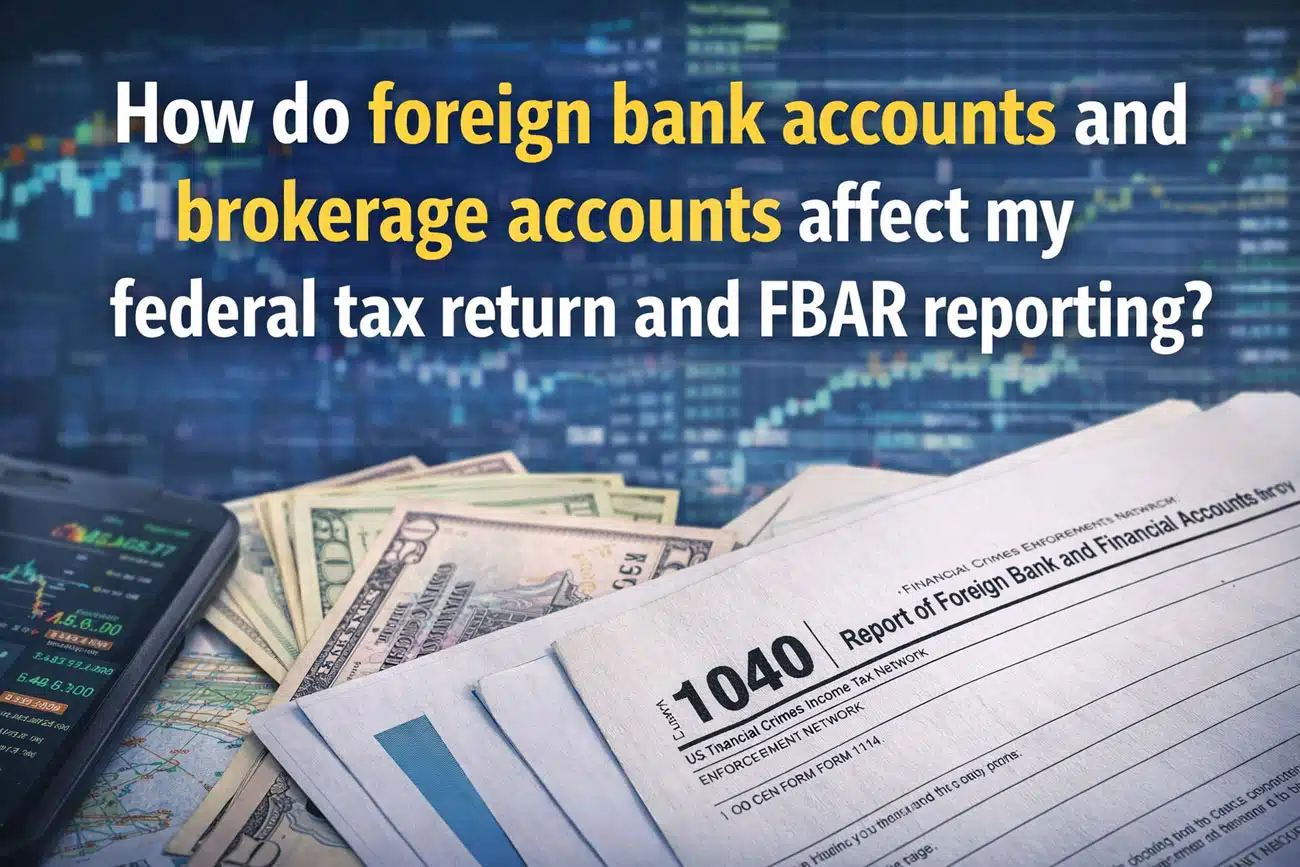
How do foreign bank accounts and brokerage accounts affect my federal tax return and FBAR reporting?
How does FBAR relate to Form 8938, FATCA, and federal tax return reporting? Foreign bank accounts and brokerage accounts can trigger multiple reporting obligations, even when the income tax impact seems minimal. Interest, dividends, or capital gains earned from foreign financial accounts generally must be reported on the federal tax return as part of taxable income. Separately, the existence of those accounts may trigger FBAR filing if account balances exceed the reporting threshold at any point during the year.
Reporting financial interest in foreign accounts requires careful coordination between FBAR reporting and income tax disclosures. Brokerage accounts, retirement-style accounts, and certain jointly held accounts may all count for FBAR purposes, even if no withdrawals occurred. Errors often arise when taxpayers assume that reporting income alone satisfies all requirements. Reviewing how foreign assets affect both reporting regimes, including FATCA disclosures, is essential for compliance. Additional context on how foreign accounts intersect with broader tax obligations is outlined in the key tax considerations for US expats living abroad.
Need Help Filing Your Taxes?
Common FBAR filing scenarios and practical guidance
How to report joint accounts, trust accounts, and accounts with foreign financial institutions
Common FBAR filing scenarios and practical guidance often start with understanding how different account types are treated under FBAR rules. Joint accounts must be reported by each individual who has a financial interest or signature authority, even if only one person contributed funds. Trust accounts, retirement-style accounts, and certain foreign investment structures may also trigger the FBAR filing requirement when the reporting threshold is exceeded. Accounts held with foreign financial institutions, including checking, savings, and brokerage accounts, are all considered foreign financial accounts for FBAR purposes, regardless of whether they produce taxable income.
Practical reporting requires careful review of account ownership, signing authority, and maximum account balances during the year. Many common FBAR errors arise when taxpayers assume a jointly held or trust account is reported by someone else. Each person required to file must submit an FBAR electronically through the BSA e-Filing system. Clear guidance on how these account types interact with broader tax obligations is covered in the key considerations for US expats with foreign accounts.
What to do if you discover a missed FBAR from prior years—delinquent FBAR submission and correction
Common FBAR filing scenarios and practical guidance frequently include situations where a taxpayer realizes an FBAR was not filed in prior years. Missing an FBAR does not automatically mean penalties will apply, but it does require prompt and accurate correction. Delinquent FBAR submission procedures allow individuals to file late FBARs electronically through FinCEN’s BSA e-Filing system, often with an explanation of why the original filing was missed. These procedures are designed for taxpayers who properly reported income on their tax returns but failed to submit the FBAR.
Addressing a late FBAR involves identifying all foreign bank and financial accounts, determining the highest balances for each year, and ensuring the submission clearly states the reason for filing late. Timing, consistency, and documentation matter when correcting past FBAR reporting. In more complex cases, streamlined filing compliance procedures may apply, particularly when multiple years are involved. A structured overview of correction options is outlined in the complete guide to streamlined filing compliance procedures.
How to prove compliance: documentation, record-keeping, and working with a tax professional
Common FBAR filing scenarios and practical guidance emphasize that proving compliance is just as important as filing correctly. Taxpayers should retain records showing account ownership, maximum balances, account numbers, and the names of foreign financial institutions for each reported account. These records support FBAR reporting and may be needed if questions arise from FinCEN or the IRS. Maintaining consistent documentation also helps align FBAR filings with federal tax return disclosures and FATCA-related forms.
Strong record-keeping reduces risk and simplifies future filings, especially when account structures change or balances fluctuate. Bank statements, annual summaries, and confirmation of electronic FBAR submissions should be kept for the required retention period. In situations involving multiple accounts, joint ownership, or prior-year corrections, coordination with a tax professional helps ensure reporting is complete and consistent across all filings. This approach supports long-term compliance and minimizes exposure to penalties associated with incomplete or inaccurate FBAR reporting.
Conclusion
Conclusion content around FBAR filing should leave no doubt that understanding the rules is essential for anyone with foreign bank and financial accounts. FBAR requirements are separate from a federal tax return, yet closely connected through income tax reporting, Form 8938, and FATCA obligations. Missing an FBAR filing requirement, misunderstanding the reporting threshold, or overlooking accounts such as checking, savings, or brokerage accounts can lead to penalties for not filing, even when no tax is owed. Knowing when you need to file an FBAR, how FinCEN Form 114 is submitted through the BSA e-Filing system, and how extensions to October 15 work helps reduce risk and uncertainty. Clear record-keeping, accurate reporting of financial interest, and awareness of FBAR deadlines are key parts of staying compliant year after year.
For many taxpayers, FBAR filing rules and correction options such as delinquent FBAR submission procedures or streamlined filing compliance procedures can feel complex and stressful. This is where working with experienced professionals makes a measurable difference. If you want expert support to handle your FBAR, foreign financial accounts, and related tax filing obligations from start to finish, US Tax Pros can help simplify the process and reduce risk. Learn how comprehensive support works through online US tax filing made easy or explore tailored guidance through specialist tax consulting services. Getting the right help ensures your FBAR is filed correctly, on time, and with confidence.